

Barrier-disrupted vs. sensitive skin: what's the difference?
Sensitive skin and barrier-disrupted skin are often used like they mean the same thing.
They overlap, but they are not identical.
Sensitive skin describes skin that tends to react more easily. Barrier-disrupted skin describes skin whose protective outer layer is not functioning as well as it should. One is more about reactivity. The other is more about barrier function.
Understanding the difference matters because the way you care for your skin should match what your skin is actually experiencing.
What is sensitive skin?
Sensitive skin is skin that reacts more easily to products, weather, heat, friction, cleansing, fragrance, or other environmental triggers.
It is often described through sensations rather than one specific visible sign. Sensitive skin may feel like stinging, burning, itching, tingling, tightness, or discomfort, even when there is no obvious rash or irritation. Scientific reviews describe sensitive skin as a condition involving unpleasant sensations such as stinging, burning, itching, and tingling in response to stimuli that normally should not cause that reaction.
In simpler terms, sensitive skin is skin with a lower tolerance threshold.
It may be naturally reactive, genetically influenced, hormonally influenced, or connected to environmental exposure. It can also be temporary, especially when the skin is stressed.
What is barrier-disrupted skin?
Barrier-disrupted skin means the skin’s outermost protective layer, the stratum corneum, has become compromised.
The skin barrier helps keep water in and external stressors out. When it is disrupted, the skin may lose water more easily, feel dry or tight, and become more vulnerable to irritation. Transepidermal water loss, or TEWL, is commonly used in research as a marker of skin barrier function because it measures water loss through the stratum corneum.
Barrier-disrupted skin often feels uncomfortable because the surface is no longer holding moisture as effectively.
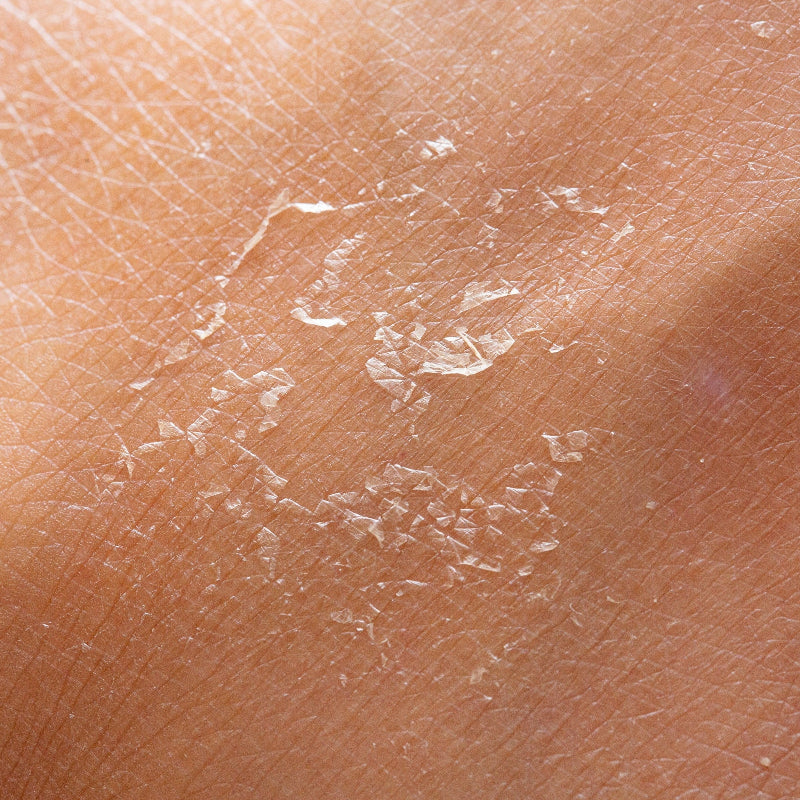
It may look dry, flaky, red, dull, rough, or shiny-tight. It may also sting when you apply skincare, even if the product is not especially strong.
The simple difference
The easiest way to separate them is this:
Sensitive skin is a tendency to react.
Barrier-disrupted skin is a state of reduced barrier function.
Sensitive skin can be your skin’s baseline. Barrier disruption is often something that happens to the skin after stress, over-cleansing, over-exfoliation, harsh weather, too many actives, or an irritating routine.
That said, the two can overlap.
Sensitive skin is more likely to feel barrier disruption quickly, because it may have a lower comfort threshold. Barrier-disrupted skin can also become temporarily sensitive because the protective surface is compromised.
How they can look the same
This is where it gets confusing.
Both sensitive skin and barrier-disrupted skin can involve:
Redness. Tightness. Stinging. Dryness. Burning. Itching. Discomfort after skincare.
This overlap is why many people assume they “just have sensitive skin” when their skin may actually be barrier-stressed. It is also why some people keep adding calming products without realizing their routine may need to be simplified first.
The visible signs can be similar, but the pattern is often different.
Signs your skin may be naturally sensitive
Your skin may be sensitive if it has always reacted easily.
You may notice that your skin does not tolerate fragrance well. It may flush with temperature changes. It may sting from certain cleansers, sunscreens, or active ingredients. You may have a small group of products that work for you, while many others feel uncomfortable.
Sensitive skin often has a repeated pattern. It is not always linked to one product, one week, or one routine mistake. It may simply be how your skin tends to respond.
Signs your skin may be barrier-disrupted
Your skin may be barrier-disrupted if it feels suddenly less tolerant than usual.
Maybe your normal cleanser now leaves your face tight. Maybe a serum that used to feel comfortable now stings. Maybe your moisturizer does not seem to last. Maybe your skin feels dry and oily at the same time.
Barrier disruption often has a before-and-after quality.
Your skin was tolerating more, and now it is tolerating less.
Common triggers include frequent exfoliation, strong retinoids, harsh cleansing, low humidity, cold weather, sun exposure, stress, or changing too many products at once. Reviews on epidermal barrier function describe the stratum corneum as central to water retention and protection, which is why disruption can show up as dryness, roughness, and increased reactivity.
Can sensitive skin become barrier-disrupted?
Yes.
Sensitive skin can become barrier-disrupted when it is pushed past its tolerance point. This can happen from a routine that is too active, cleansing that is too stripping, or environmental stress that the skin cannot comfortably balance.
This is why sensitive skin often benefits from a barrier-first approach.
Not because every sensitive skin concern is caused by the barrier, but because the barrier is part of how skin maintains comfort, hydration, and resilience.
Can barrier-disrupted skin become sensitive?
Also yes.
When the barrier is compromised, products and environmental stressors may feel more intense. Skin that normally tolerates a routine may start to sting, flush, or feel hot.
In this case, the sensitivity may be temporary.
Once the skin is given enough support, hydration, and time away from unnecessary stressors, it may become more tolerant again.
How to care for sensitive skin
Sensitive skin usually needs consistency.
The goal is to avoid unnecessary triggers and build a routine the skin recognizes. This often means fragrance-free or low-irritation formulas, gentle cleansing, thoughtful hydration, and careful introduction of active ingredients.
Sensitive skin does not always need a complicated routine. In many cases, it needs a routine that is steady, calm, and predictable.
How to care for barrier-disrupted skin
Barrier-disrupted skin usually needs recovery.
That means reducing what may be adding stress and focusing on what helps the skin feel comfortable again. A barrier-supportive routine often includes humectants, emollients, and lipids that support hydration and reduce water loss.
Ingredients such as glycerin, hyaluronic acid, sodium PCA, amino acids, ceramides, niacinamide, and barrier-supportive lipids are commonly used in formulas designed for hydration and skin comfort.
For a short period, it may also help to pause stronger actives like exfoliating acids, retinoids, and aggressive treatments until the skin feels more settled.
Which one do you have?
Ask yourself what changed.
If your skin has always reacted easily, you may have sensitive skin.
If your skin suddenly feels tight, dry, shiny, rough, flaky, or reactive after a period of stronger products, weather changes, stress, or routine switching, your barrier may be disrupted.
And if both feel true, that is common.
Many people have sensitive skin that becomes barrier-disrupted more easily. The answer is not to label the skin as difficult. The answer is to understand what it is asking for.
The TSOS approach
At TSOS, we think of sensitive skin and barrier-disrupted skin as related, but not interchangeable.
Sensitive skin needs respect.
Barrier-disrupted skin needs support.
Both benefit from a routine that starts with the skin barrier.
Barrier-first skincare does not mean doing less forever. It means building the conditions for skin to feel more comfortable, hydrated, and resilient before asking it to do more.
Reviewed by Connor Greig, P.Chem
Professional Chemist and Founder, TSOS Skincare
Sources
Misery L, Ständer S, Szepietowski JC, Reich A, Wallengren J, Evers AW, Takamori K, Brenaut E, Le Gall-Ianotto C, Fluhr J, Berardesca E, Weisshaar E. Definition of Sensitive Skin: An Expert Position Paper from the Special Interest Group on Sensitive Skin of the International Forum for the Study of Itch. Acta Derm Venereol. 2017 Jan 4;97(1):4-6. doi: 10.2340/00015555-2397. PMID: 26939643.
Del Rosso JQ, Kircik L. Skin 101: Understanding the Fundamentals of Skin Barrier Physiology-Why is This Important for Clinicians? J Clin Aesthet Dermatol. 2025 Feb;18(2):7-15. PMID: 40078856; PMCID: PMC11896616.
American Academy of Dermatology Association. Dermatologists’ Top Tips for Relieving Dry Skin.

Leave a comment
This site is protected by hCaptcha and the hCaptcha Privacy Policy and Terms of Service apply.